
There comes a moment in childhood when the world stops being just noise, colour and movement — and begins to become your world.
You do not know it is happening. You are too young to name it. But somewhere deep inside, memories begin to form. Feelings attach themselves to places. Voices become familiar. Streets become part of you. Family becomes your first map of the world.
Looking back now, I realise my awakening was not some quiet, gentle moment of clarity.
It came with sound, warmth, laughter and argument.
Football on the wireless. Scores shouted across the street. Music drifting in and out of houses. Politics being debated over cups of tea as if the fate of the world depended on it.
I was only a kid, of course. I did not understand half of what was being said. But I could feel it. I could feel that it mattered.
Football, music and politics — the triumvirate of any good Liverpool conversation.
Those were the sparks. Without asking for them, they found their way into me before I even knew what they meant.
My earliest memories are of growing up around my Nan’s houses on Sellar Street and Easby Road in Kirkdale. To me, those houses were full of warmth, laughter and belonging.
My aunties and uncles would drift in and out all day, each bringing a bit of the world with them. Uncle Jim, a proud docker, would sit me on his knee and “teach” me to read using the Morning Star, his paper of choice.
So while other kids were starting with “cat” and “dog”, I was sounding out words that probably had half the room arguing before I had even finished the sentence.
It must have worked, though. I became a decent little reader.
Nan’s house was not just a house. It was the centre of a little universe.
My Aunty Lilly and Uncle Gerry were close enough in age to my sister and me that they felt more like brother and sister than auntie and uncle. Cousins, aunties, uncles, friends, neighbours — people were always around. Doors were rarely closed. You were never really alone.
And on a Saturday morning, Nan’s house came alive.
You could call in at any time and be welcomed as if you had never left. My Nan would no sooner be up than she would be peeling potatoes. On the stove there was always a pan of scouse — a pan that, in my childhood mind, never emptied. It just kept going, topped up with more meat and vegetables as needed.
It was not just food.
It was love.
It was comfort.
It was community.
It was continuity.
I know I am looking back now through slightly rose-tinted glasses, but that is exactly how it felt. Warm. Alive. Full of life.
And if Specsavers ever start knocking out lenses like that, old four-eyes here will be first in the queue.
Maybe that is why these moments stay with us. They are not just memories. They are the first times you feel the world properly. Everything is new, intense and somehow important, even if you do not yet know why.
One memory I still carry vividly is of being picked up by my mum while she was working in the Cavern Club alongside my nan, around 1964. The Beatles had played their last Cavern gig on 3 August 1963, but the place still carried that charge, that electricity.
I remember being at the bottom of the stairs. The noise. The energy. The feeling of being surrounded by life.
Then my mum lifted me onto her hip, and I wrapped myself around her.
Safe.
Secure.
Right in the middle of it all.
That feeling — of energy, belonging and being held — has never really left me.
I still have my mum’s Cavern badge, and I wear it proudly when taking visitors on Beatles tours. I am a Certified Blue Badge Liverpool City Region Tourist Guide, for my sins.
But my earliest clear memory of all is football.
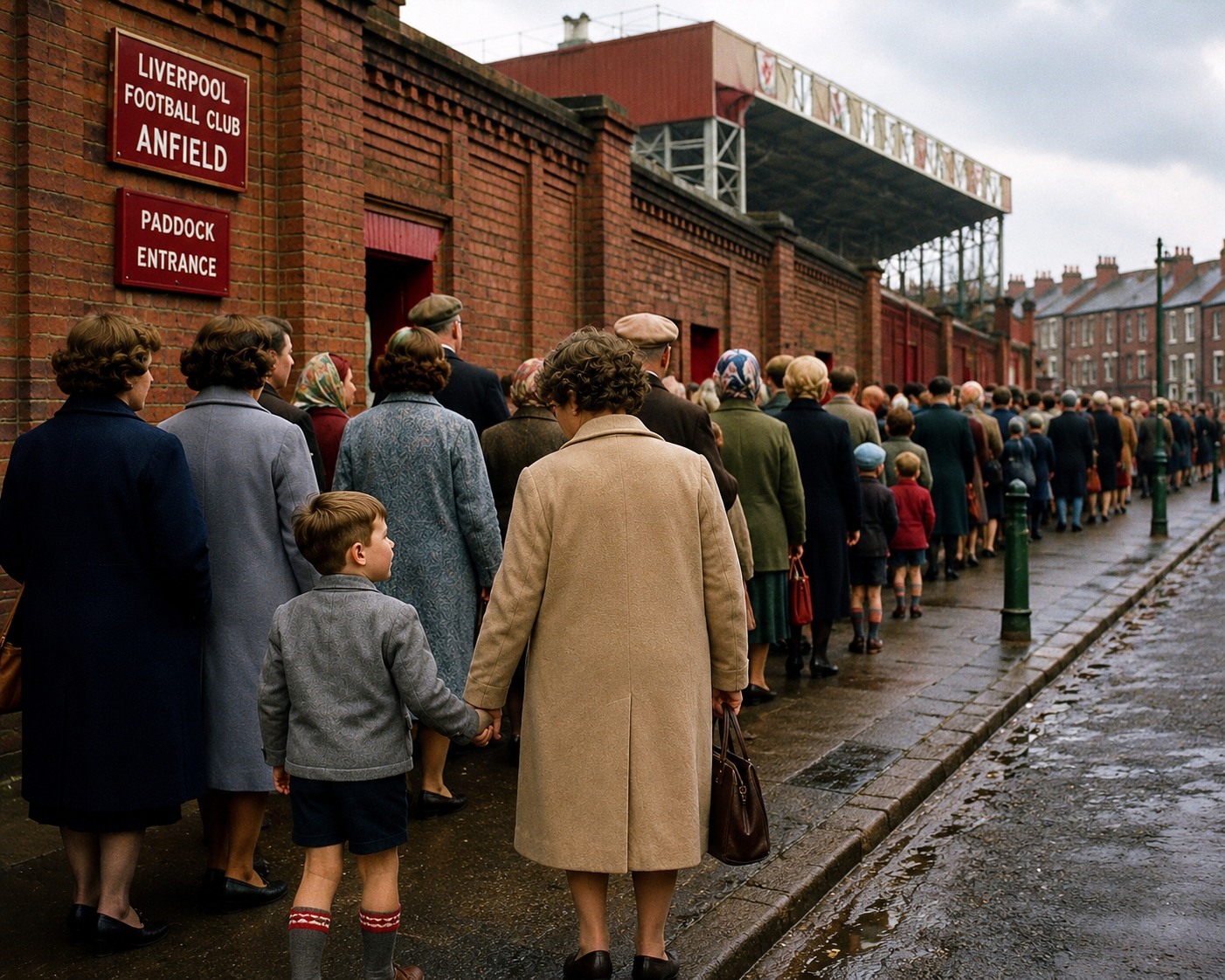
I remember standing in a queue with my Nan. I can still see my little arm stretched above my head, reaching up for her hand as we shuffled along in what felt like an endless line. We were waiting to buy tickets for a much-anticipated football match, probably an FA Cup game.
That was the moment my lights came on.
Something clicked. Something registered. It remains as vivid today as it was on those damp streets around Anfield in the early 1960s.
My earliest clear memory is not of school.
Not of home.
It is of standing with my Nan in a queue for football tickets.
Football had no colour for me then. Red and blue would come later.
But already, like so many Liverpudlians, football was there at the very beginning of consciousness. Something real. Something felt. Something everywhere.
I must have sensed the significance of what we were doing. It mattered enough to have my Nan standing in a queue for hours. With many of the men working during the day, it was often the women who held the line — quite literally — making sure the men in the family did not miss out on going the game.
And that ninety minutes of football never stayed on the pitch.
It rippled through the streets, the houses, the pubs and the conversations. It shaped moods, plans and the very feel of the city itself.
Saturdays were the highlight of my week.
I would get a couple of bob and head off to the Astoria Picture House on Walton Road for the ABC Minors morning cinema. Those mornings felt magical: cliff-hangers, Harryhausen’s Sinbad adventures, Batman serials — stories that swept you away and filled your world with colour and imagination.
Then, after the films, the day would turn to football.
If Everton were at home, my Everton-supporting uncles, mostly the Ellises, would say, “’Ere y’are, Michael, go the game, lad.”
If Liverpool were playing at Anfield, the Smiths would do the same.
So, week by week, I found myself at Goodison Park or Anfield, carried along by something far bigger than just a game.
What stands out most, looking back, is the spirit of those days. The rivalry between red and blue was real, but it was warm. It had humour. It had respect. There was banter, of course — plenty of it — but it was rarely bitter.
People disagreed, laughed, argued, then shared a meal, a story or a cup of tea.
Before I was even old enough to play for a team, football already had me.
Street games were everything. Fifty kids a side. Jumpers for goalposts. And yes, it sounds like a cliché, but clichés only exist because they are true.
The road was our pitch.
That was where it all began.
But once you pulled on a proper shirt and played for a team, everything changed. The game took on a new meaning. As you grew, so did your passion — not just for watching, but for playing.
You did not simply follow football.
You carried it with you.
It became part of how you saw the world. Part of how you understood people. Part of who you were.
And let’s be honest: if your team’s result at the weekend was not reflected in your mood the following week, you were not a proper Togger head.
“Togger” is a Northern English dialect word for football. It can mean playing football, going for a game, or the game itself. To go out and play togger was to go out and play football or footy.
And in Liverpool, togger was never just togger.
It was family.
It was streets.
It was pride.
It was memory.
It was identity.
In truth, it is impossible to take football out of the story of Liverpool. It is woven into the fabric of the city — into its communities, its conversations, its loyalties, its humour and its heart.
That is the spirit behind ToggerTours.
It is not just about showing people stadiums.
It is about sharing the soul of a football city.
It is about walking the streets where the game took root. Hearing the stories behind the clubs, the grounds, the pubs, the people and the communities. Feeling the heartbeat of a city where football has always meant more than ninety minutes.
Come with us.
Breathe in the air of a football-mad city.
From the giants of the game to the forgotten roots of Liverpool football, ToggerTours is here to tell the story properly — with passion, pride, warmth and truth.
In a city of two fiercely supported teams, football may divide us on the surface.
But underneath, it binds us together with something far deeper.
It always has.
And it always will.
Welcome to ToggerTours.